
Glass Protection Film
Premium Glass Protection Film
-
- Designed to temporarily protect glass surfaces
- Removes clean, without leaving any residue behind
- Materials: Polyethylene Film coated with a water-based acrylic adhesive
- Solvent-Free sustainable adhesive
- Available colors: Clear or Blue
Product Details
Our glass protection film preserves the pristine condition of the glass surface from manufacturing through to end-use ready. The film shields glass from scratches, abrasions, markings, chips, dirt, and chemical contamination, as well as damage that could occur during shipping, storing, and installation.
Glasss Protection Film Specifications
Roll Size: All films are available in custom sizes up to 60″ width and up to 5,000′ finished
Perforations: Custom perforations as well as standard perforations of 2″, 3″, 4″, 6″, 7″, 8″, 12″, 21″, 24″.
20L20
- Adhesion to Steel: PSTC-101 (oz/in): 1.0 to 2.0
- Tack Level: Extra Low
- Tensile Strength: PSTC-131 lb/sq in: 7
- Elongation (%): PSTC-131: 325
- Thickness: PSTC-133: 1.6 mils (nominal)
We're Here to help
Our team is available to help with product questions, find the right solution for your business, or provide a quote. Contact us to get started.
BENEFITS
Benefits of Presto Tape's Glass Protection Film
Optimizes Labor Allocation
Reduces need for last-minute glass prep or protection by crews, enabling faster workflows.
Enhanced Brand Perception
A flawless reveal enhances perceived product quality, boosting customer satisfaction, brand image, and the likelihood of repeat business.
Minimizes Breakage Rework
Maintains integrity of the glass during shipping and on-site movement, reducing warranty claims and loss.
PROCESS USE
Glass Protection Film is designed to safeguard glass surfaces throughout shaping and fabrication, including production forming, edge finishing, and sealant application, while protecting against scratches, chips, abrasion, and contamination during assembly and handling. The film provides reliable temporary protection during in-plant transportation, warehouse storage, and delivery, reducing damage caused by friction, debris, and repeated contact. During installation and on construction or renovation sites, it helps shield glass from dust, tools, sealants, and incidental contact, preserving surface quality and optical clarity until final removal.
The film can be used for specific uses, including:
Shaping
When large glass sheets are cut, drilled, or shaped, the delicate surface must be protected from abrasive machinery, tooling, and accidental contact. The film also contains glass dust and small shards, preventing them from contaminating newly exposed surfaces.
Sealant Application
The film can also function as a masking layer during the application of sealants or adhesives for other components. This prevents these materials from adhering to areas of the glass that need to remain clean, simplifying post-application cleanup and ensuring a perfect finish.
Handling
Installers often handle large, heavy, or awkward glass components. The film minimizes the risk of damage during the often-tight, challenging installation process.
APPLICATION USE
The film is suitable for a range of applications.
Annealed Glass
This is the most typical type of glass and is relatively fragile, so a protective film is essential to prevent scratches and breakage during handling.
Tempered Glass
It’s stronger than annealed glass, but protective film is widely used to prevent surface damage during manufacturing and installation.
Tinted Glass
Glass that has a colorant added to reduce glare and heat transmission. Protective film is applied to prevent scratches and maintain the aesthetic appeal of the tinted surface.
Mirrors
Protection film is used to safeguard the delicate reflective surface and the glass itself from scratches, particularly during fabrication and handling.
Acid-Etched Glass
This glass has a frosted or matte finish created by acid treatment. The delicate etched surface can be prone to fingerprints and smudges, making a temporary protective film beneficial.
HOW TO APPLY & REMOVE PROTECTIVE FILM
Applying the Film
Applying Glass Protection Film during Glass Fabrication
1. Clean the Glass: Use an industrial glass washer or lint-free wiping system and dry the glass completely to prevent adhesion failure.
2. Load the Glass: Feed the cleaned glass into the film application station (flatbed laminator or pressure roller system).
3. Setup the Film: Align and tension the glass protection film roll on the unwind shaft above the application zone.
4. Feed the Film: Advance the film to make initial contact with the glass as it enters the nip of the rollers.
5. Adhere the Film: Use pressure-adjustable rubber or silicone rollers to bond the film to the glass as it passes through.
6. Edge Trimming: Trim excess film with inline slitters or downstream automated blade systems for edge precision.
Applying Glass Protection Film by Hand or Applicator
1. Surface Cleaning: Clean the glass using a glass cleaner or isopropyl alcohol and a lint-free cloth or microfiber towel.
2. Dry the Glass: Ensure the surface is completely dry using a clean cloth to prevent adhesion issues.
3. Prepare the Work Area: Set up a clean, dust-free space with a flat surface for application. Use gloves to avoid fingerprints.
4. Cut the Film to Size: Measure the glass and cut the protection film slightly oversized to allow edge trimming after application.
5. Peel and Position the Film: Peel back a small section of the film and align it at one edge of the glass, adhesive side down.
6. Apply the Film by Hand or Roller: Slowly apply the film across the glass, smoothing it out with a felt squeegee or hand roller to avoid bubbles.
7. Work Out Air Bubbles: Use the squeegee to push air bubbles from the center toward the edges in smooth, overlapping strokes.
8. Trim Excess Film: Carefully trim the overhanging film using a sharp utility knife and a straight edge for a clean finish.
Removing the Film
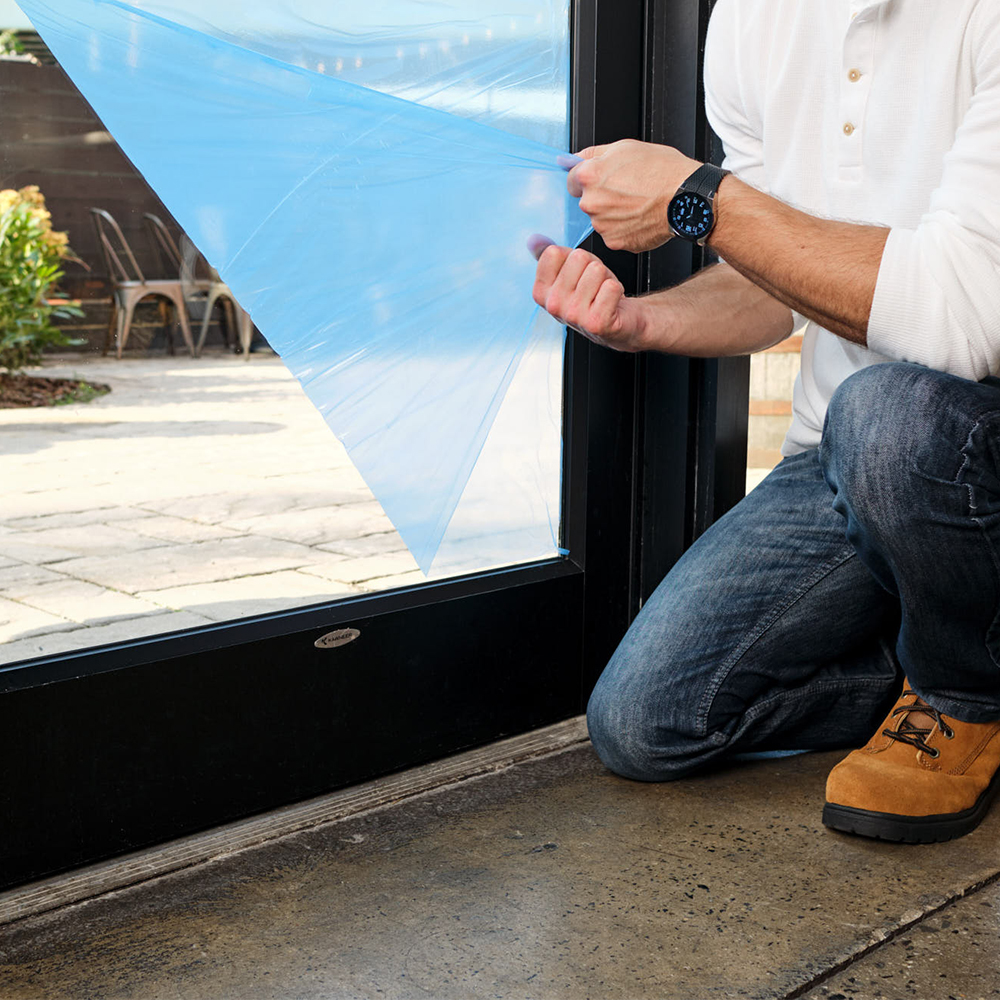
| 1. Prepare the Area: If possible, ensure the glass surface is cool, avoid direct sunlight or very hot glass, which can make the adhesive stickier. 2. Locate a Starting Corner or Edge: Find a corner or edge of the film that is accessible. If the film is tightly adhered, you might need to use the edge of a plastic scraper to gently lift a small section. 3. Peel Slowly and Consistently: Once you have a lifted edge, peel the film back at a low, consistent angle, ideally between 45 to 180 degrees, pulling directly back onto itself. 4. Final Cleaning: Clean the glass surface with a standard glass cleaner and a clean, lint-free cloth to achieve a sparkling, streak-free finish. |
INDUSTRIES USING PROTECTIVE GLASS FILM
Construction
Protecting windows, glass facades, balustrades, skylights, and interior glass elements from damage during construction, renovation, and painting.
Window and Door Manufacturing
The film is widely used in this industry to protect window panes and glass door inserts from damage from fabrication through installation.
Glass Manufacturing & Fabrication
From cutting and shaping raw glass sheets to tempering, laminating, coating, and finishing, glass undergoes numerous processes where it's susceptible to scratches, abrasions, and contamination.